[6 minute read]
The nightly news, social media, our own neighborhood and community groups are all a buzz: El Niño is here, bringing with it flooding and fear of more to come. Although some coastal communities are already bearing the storm surge of Kelvin waves and Pacific hurricanes, for those of us living in the upland headwaters, now is the moment of figurative calm before the literal storm.
As OAEC’s Brock Dolman put it, “Building on the classic adage, planning is best done in advance and better still, in community with many others. Only then might catastrophic storm events transform from runaway flood risk to water harvesting opportunity.”
That forward-looking ethos is why, when North Bay Jobs with Justice (NBJwJ) and their worker-owned land care cooperative—Semillas en Manos Unidas (la SEMU)—were awarded a San Francisco Economic Development Department Catalyst Grant, they invited us to collaborate. Over the past year, the OAEC team offered two week-long workforce development trainings to introduce workers to our Fuels to Flows toolkit, the Beneficial Biomass framework, and low-tech process-based restoration techniques for the uplands.
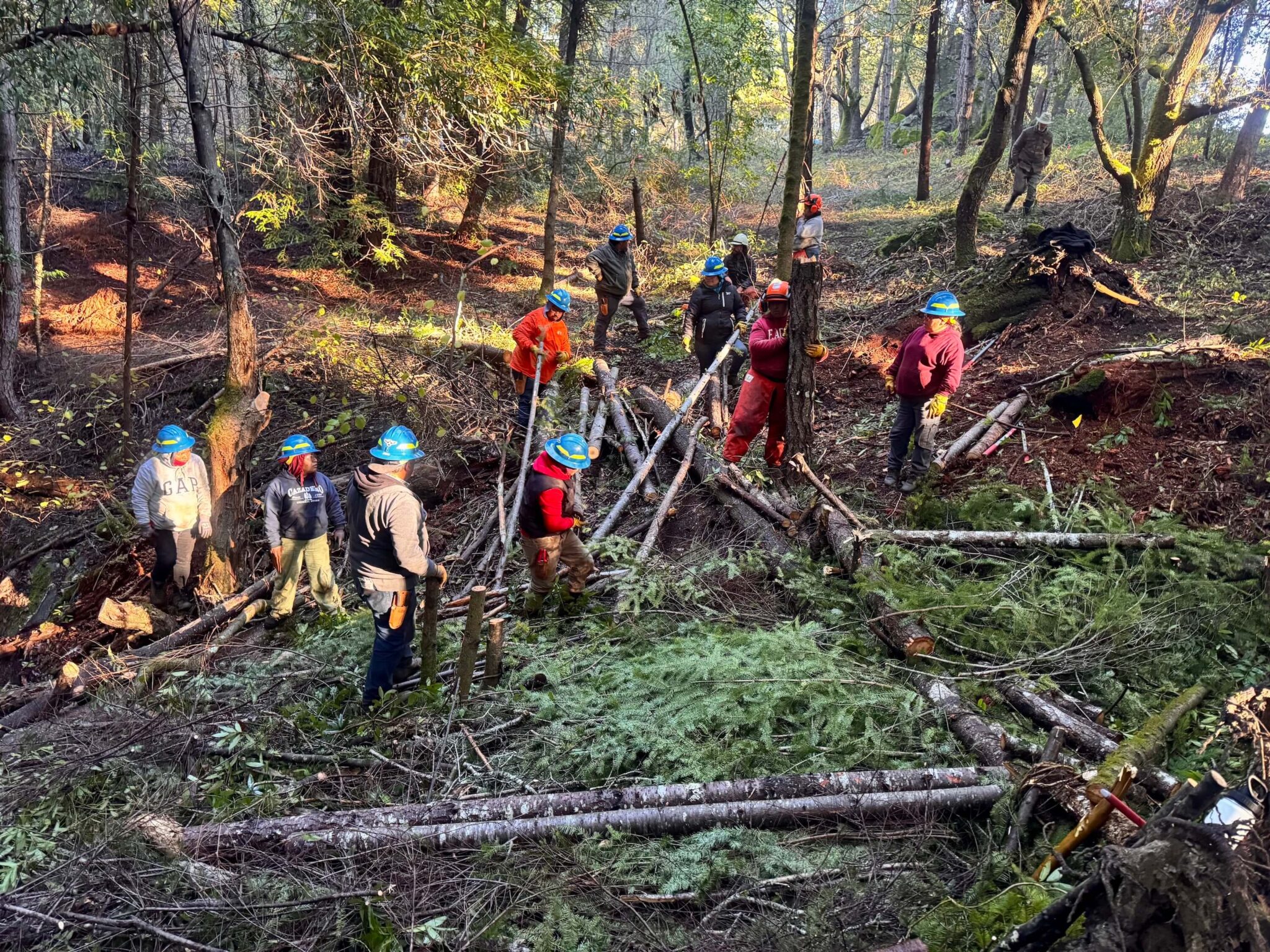
Together, our coalition implemented twenty-two gully stuffing structures which are now stabilizing 473 feet of upland channel across adjoining private and public lands.

The NBJwJ crew stuffed gullies at Two Sisters Place in early winter, 2025. After the first season of high flows, the structures are still intact and ready to slow, spread, and sink water in the uplands during the El Niño-driven 2026 storm season. Photo Credit: Brock Dolman/OAEC
Today, the watercourses at our two project sites, Two Sisters Place and Camp Meeker Community Forest, are ready to weather the coming storm to the benefit of people and salmon throughout the watershed. The gullies we stuffed will act as nature-based shock absorbers, poised to slow stormwater and sediment before it floods into the Russian River and its network of tributaries.


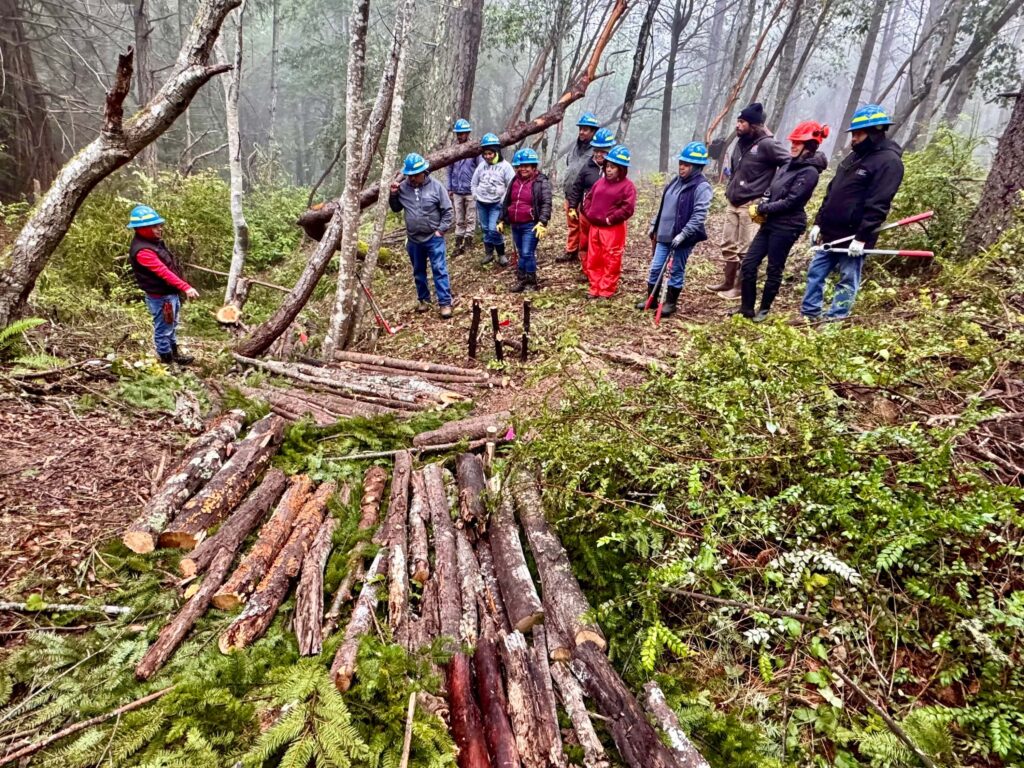
NBJwJ’s la SEMU crew builds low-tech process-based restoration structures in the Camp Meeker Community Forest during the summer of 2026. Photo Credit: Brock Dolman/OAEC
This year, our coalition kicked off gully stuffing implementation at Camp Meeker Community Forest during the heat of midsummer. We were honored to offer our training through NBJwJ’s Climate Resilience Worker Training Program that supports local workers in redirecting their labor towards the deepening impacts of the climate crisis while organizing towards a just transition. The week-long workshop was lively: a cheerful crew worked together to strategically layer and pack channel beds with small green branches and tan oak sprouts into a dense, interlocking mat. Others hauled and carefully positioned hundreds of larger logs onto the channel structure to weigh it down or pin sections into place—an especially important touch during winter rain events that trigger high flows.
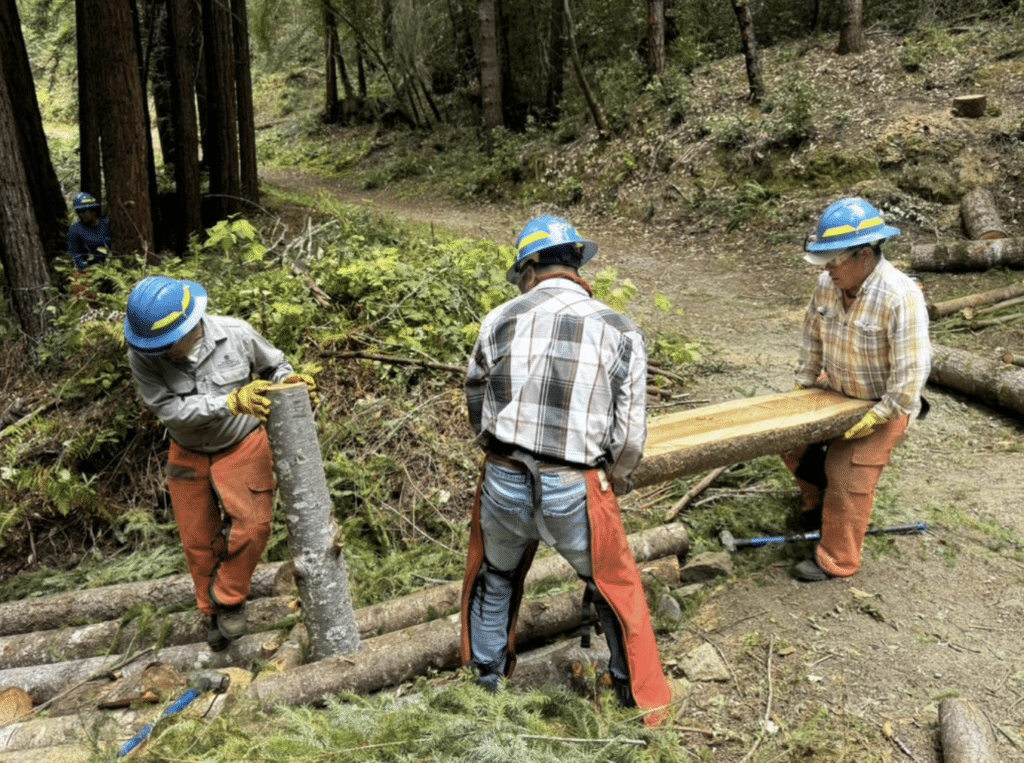
Placing larger logs onto the channel structure helps to pin down lighter materials. Photo Credit: Brock Dolman/OAEC
During this portion of the training, the team restored 230 feet of channel and walked away as skilled gully stuffing practitioners. This technique from our Fuels to Flows toolkit, is versatile, building resilience in every season. By reusing on-site biomass generated from fuels treatments we work to reduce the risk of summer’s catastrophic wildfires. In winter, stuffed gullies slow and store stormwater to rehydrate the uplands, adding another layer of wildfire protection for later in the year, while simultaneously stabilizing flashy ephemeral streams that only carry water, in fast-moving torrents, during winter storm events.


With gully stuffing, a technique from our Fuels to Flows toolkit, we connect our fire fears to our water woes. Our 2023 NBC feature illustrated how gully stuffing and other process-based restoration installations on OAEC’s 80-acre campus increased ecosystem robustness by using onsite biomass to stabilize watercourses. Watch the clip to see how the structures held up during high flows brought by a 2023 atmospheric river. Video still courtesy of NBC.
Uniquely situated, the installations at the Camp Meeker Community Forest site repurposed biomass generated by the neighboring Hampton Road Fuel Clearance project. While there was ample availability of large logs, 4-8’’ inches in diameter, the small woody debris that we refer to as “green gauze” was in short supply. These small branches and foliage can be manually stuffed in between larger pieces to create an interlocking structure that holds it all together. Green gauze shores up gaps while also creating a permeable barrier that slows and filters the flow of water and sediment.
The team adapted to this shortage, using onsite tan oak sprouts where Douglas fir boughs were lacking; yet this low supply presented the largest barrier to project completion. This underscores the urgency of establishing efficient pathways for interagency coordination between fuel load reduction and process-based restoration installations for the mutual benefit of fire mitigation and watershed restoration efforts.
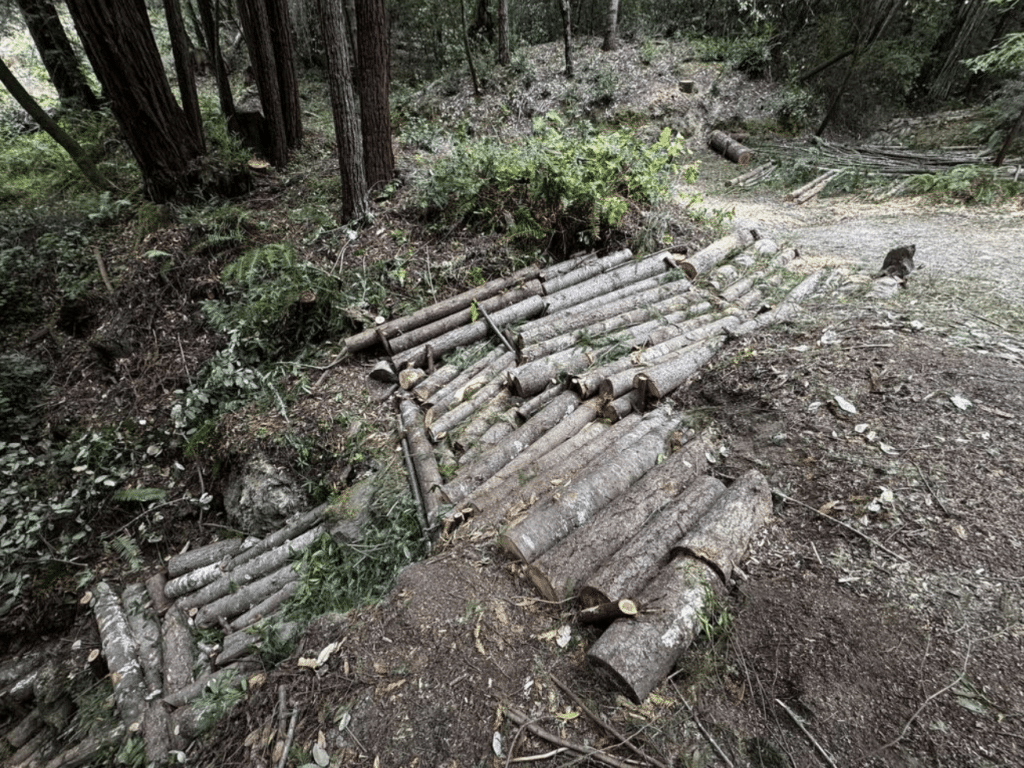
The neighboring Hampton Road Fuel Clearance Project meant there was ample biomass onsite. The gully stuffing team had plentiful access to 4-8” diameter logs, but smaller green material was scarce. Photo Credit: Brock Dolman/OAEC
Of course, every site is different. At our first training, held in December 2025 at a private property called Two Sisters Place, the crew had plenty of access to small green materials. There, workers limbed and thinned small-diameter Douglas firs encroaching on the site’s coastal prairie ecosystem. With abundant biomass we implemented 14 structures and treated 243 feet of channel, simultaneously improving water quality and quantity, reducing erosion, restoring coastal prairie habitat, and mitigating fire risk.
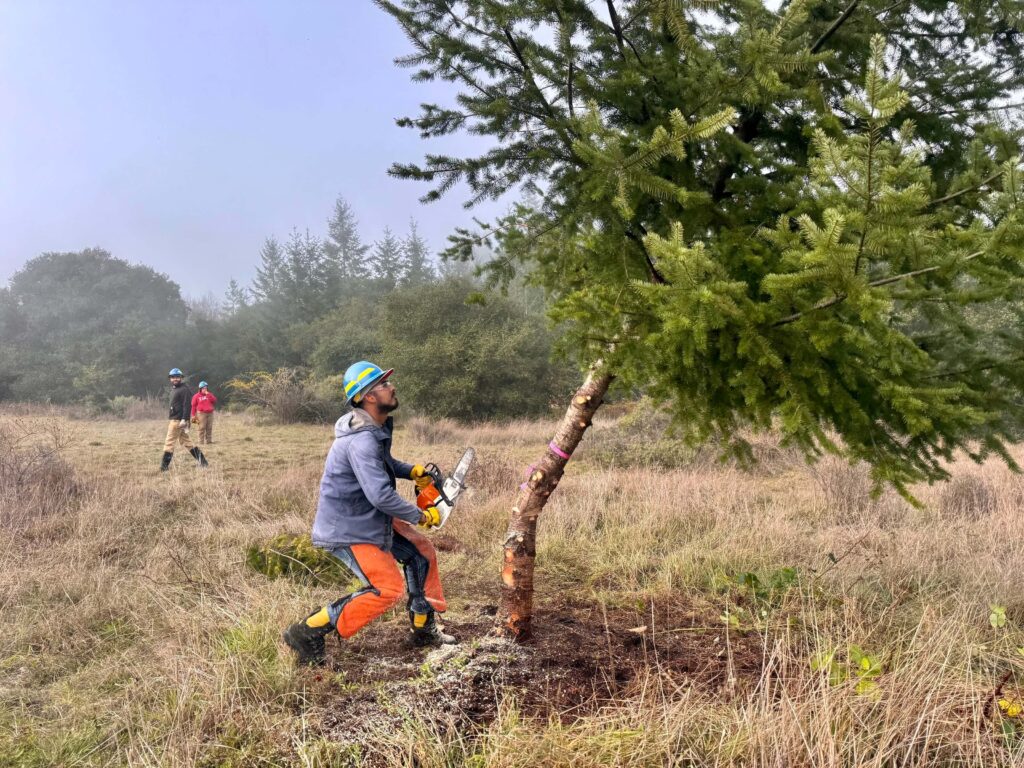
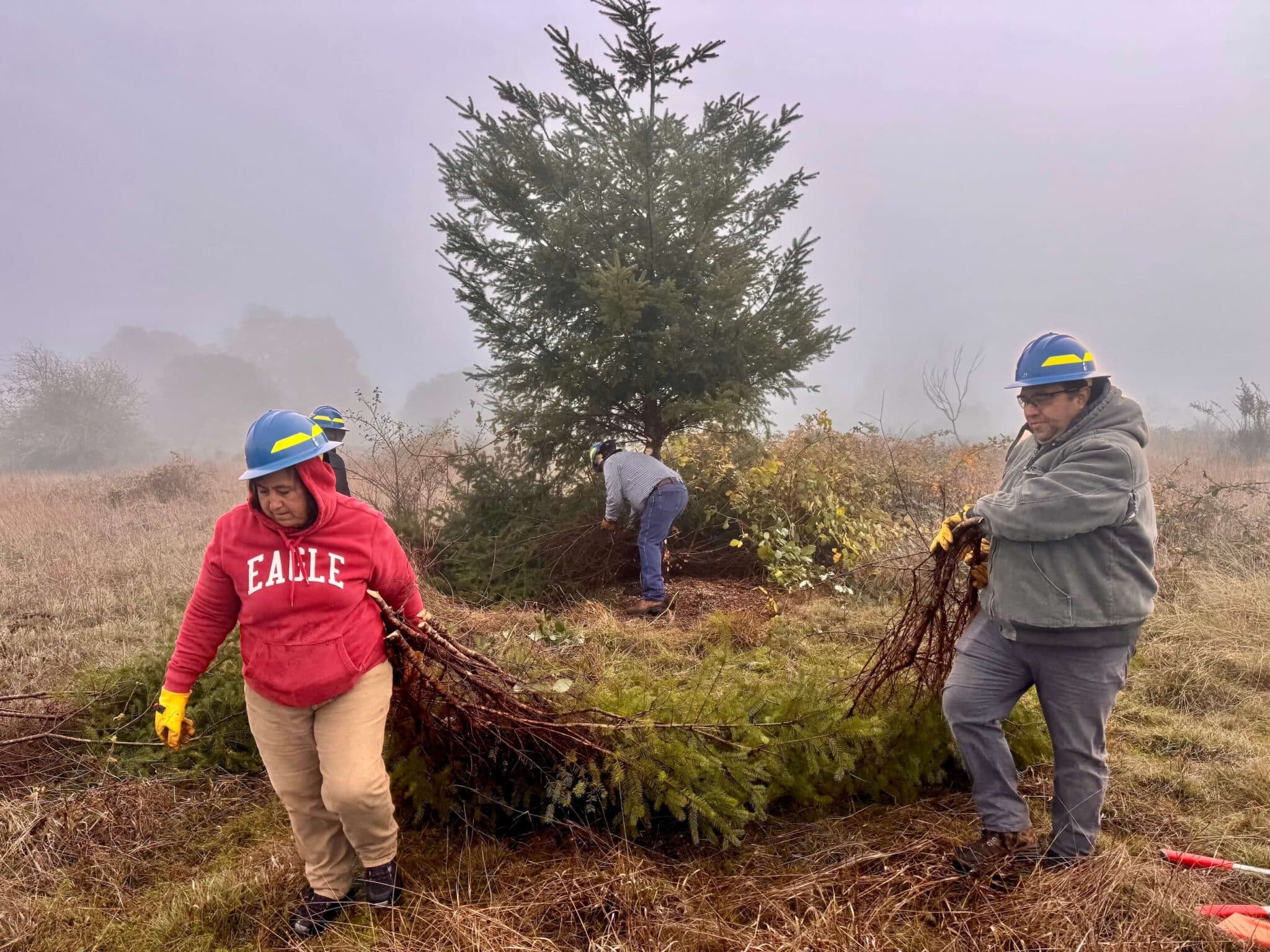
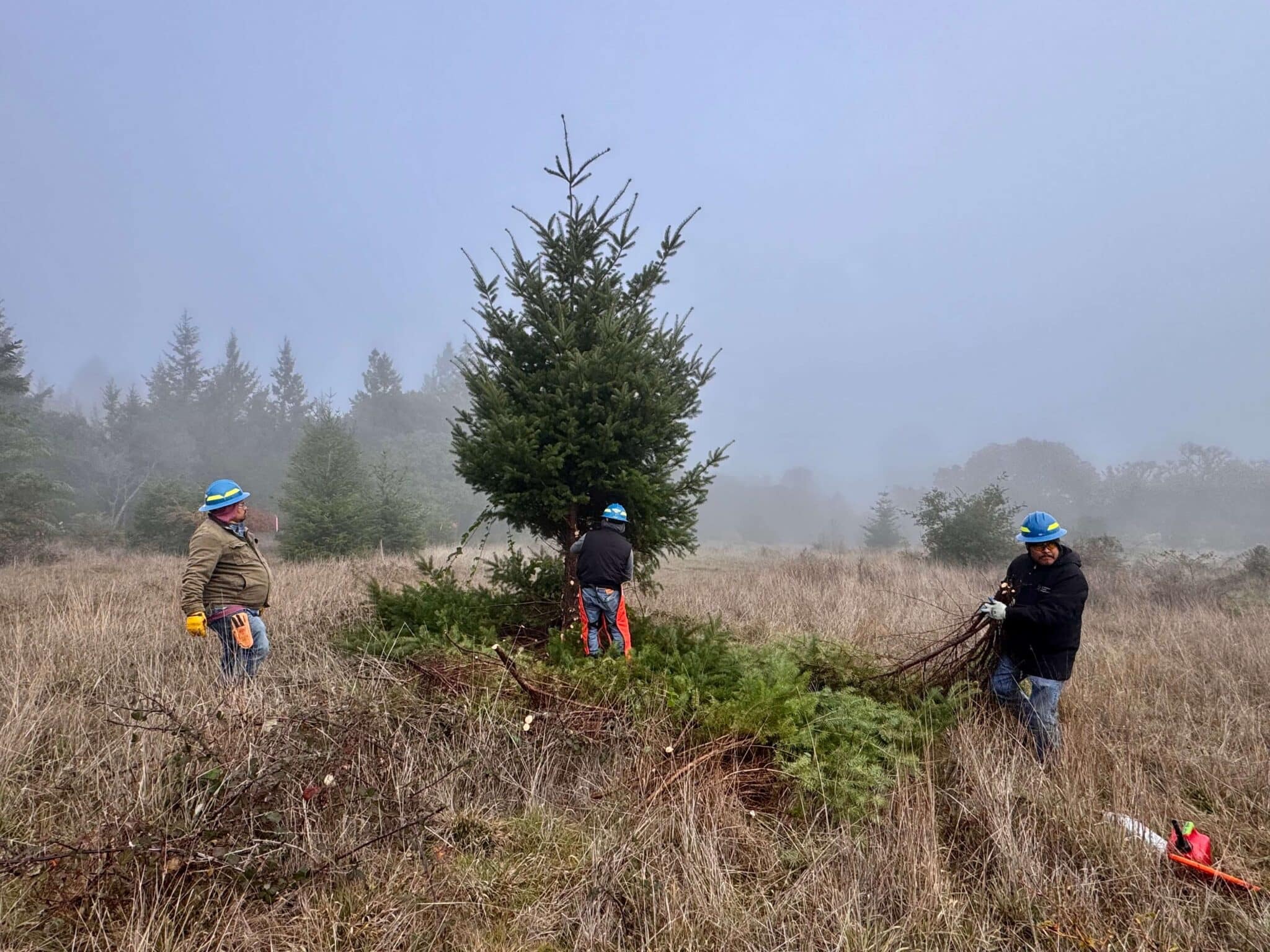
The la SEMU crew limbed and thinned small-diameter Douglas firs encroaching on the site’s coastal prairie ecosystem. This beneficial biomass was then utilized in gully stuffing projects in the watercourse adjacent to the prairie. Photo Credits: Brock Dolman/OAEC
When this suite of workforce development first started in the fall of 2025, it was already poised to operate well beyond the arbitrary boundaries of agencies, property lines, and single-issue community organizing. Each stage of the project reflected robust collaboration among nonprofits, regional and permitting agencies, worker-owned collaboratives, and private and public land managers, all ready to practice restoration as a form of regional mutual aid.
Zooming out to the watershed scale, this project demonstrates the interconnection between upland and lowland communities. Each of our project sites were situated in the upland headwaters of Dutch Bill Creek, a major tributary of the lower Russian River Basin—meaning our restoration efforts in the headwaters will go on to support stream health that benefits endangered coho salmon and threatened steelhead trout in the valley.
By conducting this work across property lines we keep our watercourses connected, bit by bit. As a prime example, the drainage treated at Camp Meeker Community Forest this summer was the downstream continuation of the work we started in 2022 on the upper portion of the same stream originating at OAEC.


At the end of the training, the NBJwJ team celebrates their hard work at the Camp Meeker Community Forest. Photo Credits: Brock Dolman/OAEC
To mitigate the impacts of El Niño-powered storms at landscape scale, many more similar installations would be needed across the uplands. But this training program is just the beginning. As this winter’s heightened storms roil through our watersheds, the work we’ve conducted in partnership with many others, effectively demonstrates what sensible, holistic, and equitable land management can look like in our communities.
Ready to bring holistic restoration to the headwaters?
Sign up to receive a free PDF of our forthcoming best management practices guide: Low-tech Process-based Restoration in the Uplands.
This project was funded by a San Francisco Economic Development Department Catalyst Grant garnered by North Bay Jobs with Justice. We are grateful for this partnership.


