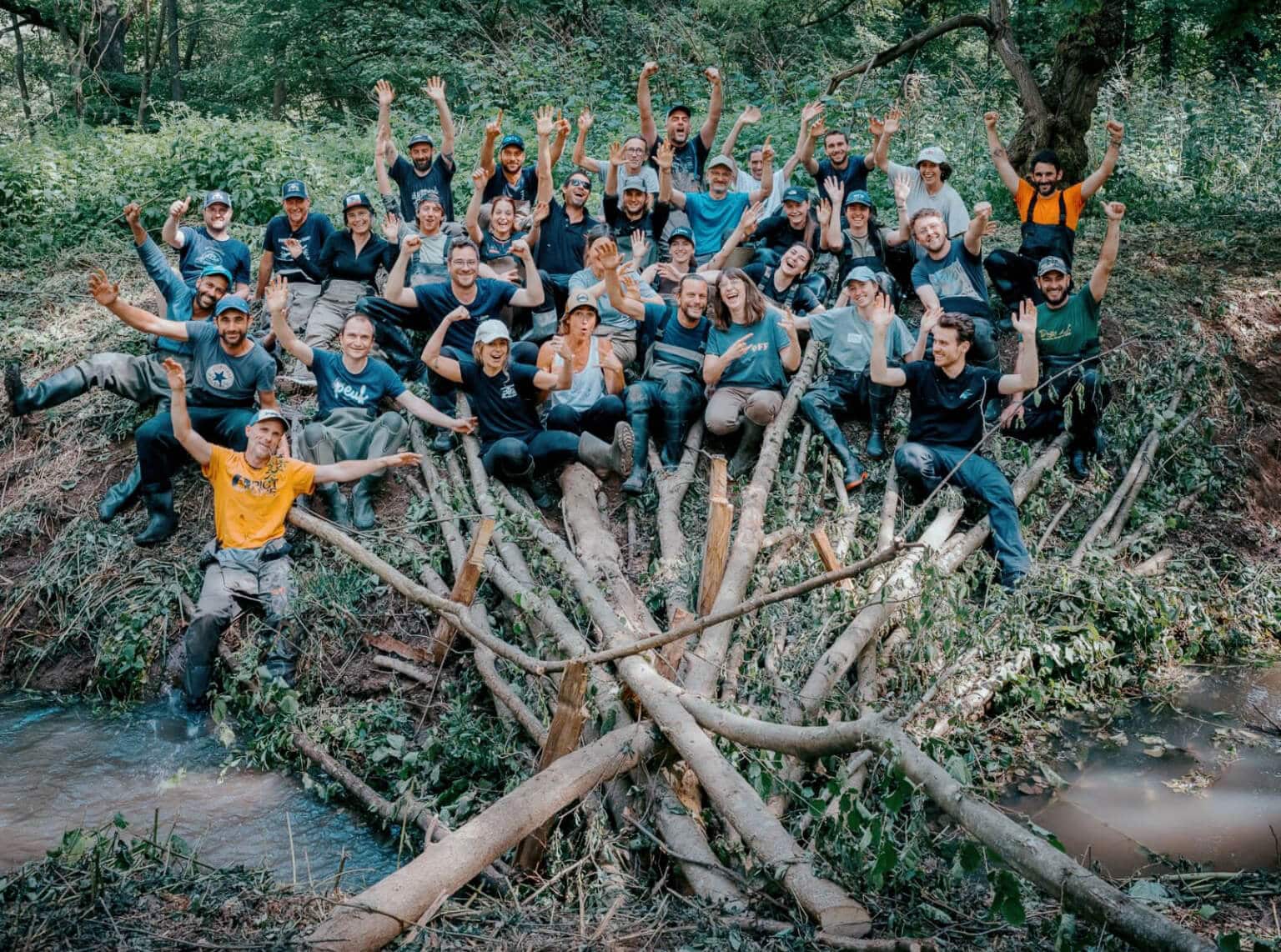
Workshop participants celebrate completion of an in-stream structure in the Charlet watershed, located in the Auvergne region.
Photo Credit: Pierre-Yves Brunaud.
This spring, WATER Institute Co-Director Kate Lundquist and her partner, Kevin Swift of Swift Water Design, led their third annual process-based restoration (PBR) training across three regions of France in partnership with Suzanne Husky, Clément Delis and other co-founders from Mouvement d’Alliance avec le Peuple Castor (MAPCa).
During their three and a half week tour, the organizing team and 135 practitioners, nonprofit partners, and policy-makers worked to augment previously built structures, designed an ambitious post-fire landscape restoration, and treated upland drainages at a working farm.
Alongside the in-stream teamwork, especially noteworthy were this year’s permitting wins, positive press, and the translation of two seminal American beaver and process-based restoration publications into French—all signals of growing public support for nature-based solutions as practical climate change mitigation strategies for France.

Workshop participants observe the effects of an in-stream structure that is restoring river hydrology by mimicking natural processes that slow water down, keeping it in the system longer. Photo Credit: Rémi Bourru, Director at Alluvia SAS.
In the months since this visit, we have seen climate-change-fueled wildfires raging in France, causing, as one BBC article puts it, “more damage in France this year than at any time since World War Two.” Amid this tragic backdrop, we are heartened and humbled by the opportunity to practice nature-based solutions with others eager to create climate-resilient communities.
A notable tour stop this year was the Rabet River, a sub-tributary of the greater Aude River watershed in southern France. This restoration site marks a significant turning point for low-tech PBR in France. After cultivating buy-in from numerous mayors and agencies, securing funding, and fostering public interest, collaborators from Syndicat Mixte des Milieux Aquatiques et des Rivières (SMMAR) secured permits to install the region’s largest and most ambitious LTPBR project to date along a ten-kilometer riparian zone that burned in a 27,000 acre wildfire in 2025.

This ten-kilometer riparian zone burned in a 2025 wildfire. Soon this area will be the site of the largest LTPBR installation in the region.
Photo Credit: Rémi Bourru, Director at Alluvia SAS.
Kate shared the significance of this project: “As French restorationists enter more regulatory processes, they’re diligently sharing their expertise with agencies and permitters, building credibility, and accelerating adoption of PBR practices across the country. Progress like this ensures that low-tech process-based river restoration can be carried out more efficiently and at scale.”
The design work carried out by Swift Water Design and MAPCa before and during this year’s onsite trainings will lay the groundwork for the full project implementation, to be carried out by Swift Water Design, OAEC, MAPCa and SMMAR in 2027 alongside local professionals.
This year, the team also returned to a site in the Charlet watershed, a sub-tributary of the Allier River, located in the Auvergne region. There, we partnered with Association Rivière Rhône-Alpes Auvergene (L’ARRAA) and colleagues Aurélien Mathevon, Fanny Morizot, and Charlène Descollogne to carry out two sold-out trainings for 35 people each.
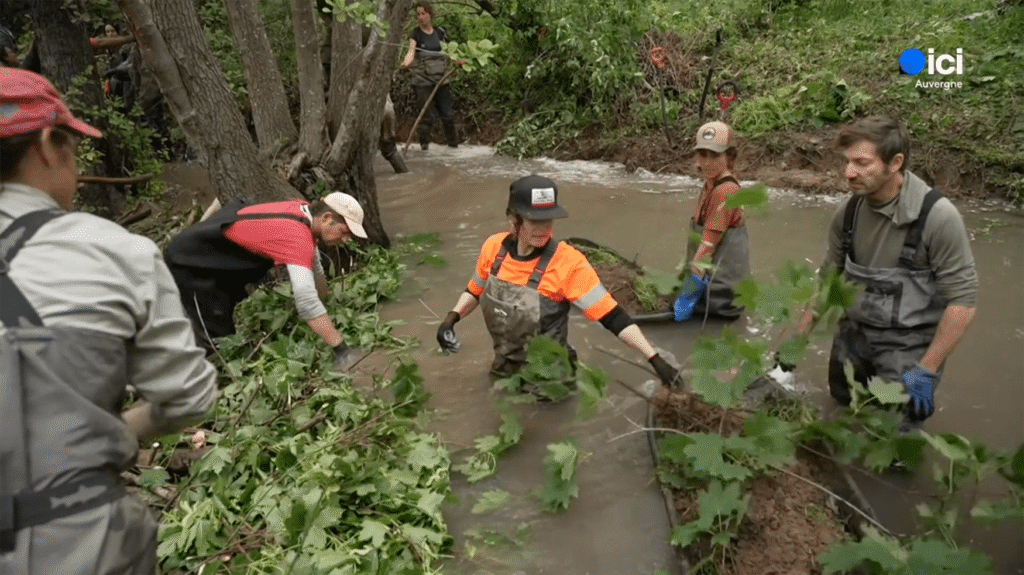
Special thanks to Aurélien Mathevon for getting the press out to cover the training. Watch the feature to see Kevin Swift (Swift Water Design) and others talk about our beaver and process-based restoration collaboration in France.
River technicians, engineers, and private practitioners came together for the in-stream build, which was even showcased on the news! This feel-good feature demonstrated how the team is positively reshaping river hydrology through beaver-based mimicry.
In other media highlights, during this year’s journey, we were delighted to see OAEC found in translation amongst the French version of “Eager: The Surprising, Secret Life of Beavers and Why They Matter.” When this watershed book launched beaver into the spotlight as climate heroes in 2019, it also prominently featured WATER Institute Co-Directors, Kate and Brock. We are thrilled that their 20 years of spirited campaigning to restore beaver in California will now inspire entirely new French-speaking audiences. Special thanks to collaborator Fanny Morizot for her thoughtful translation of this important book.

The LTPBR Design Manual for Riverscapes Pocket Guide by the Utah State University Restoration Consortium was also translated into French last fall by Fanny Morizot, Baptiste Morizot, and Suzanne Husky in collaboration with L’ARRAA. This booklet features images of OAEC and Swift Water Design collaborators hard at work in France, further illuminating our fruitful, international collaboration.
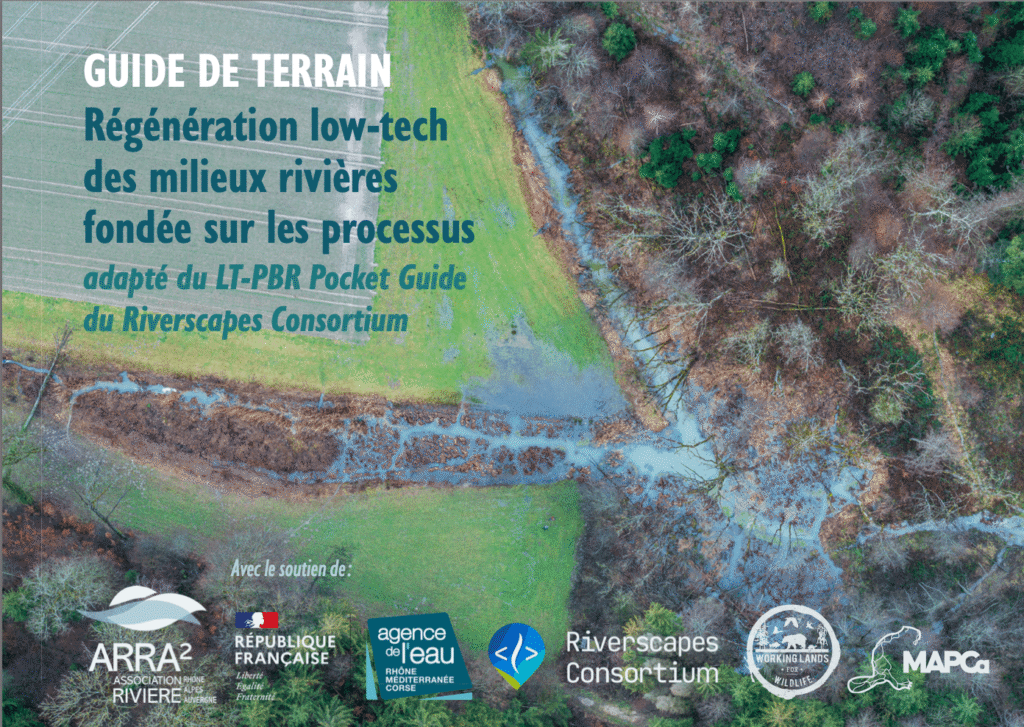
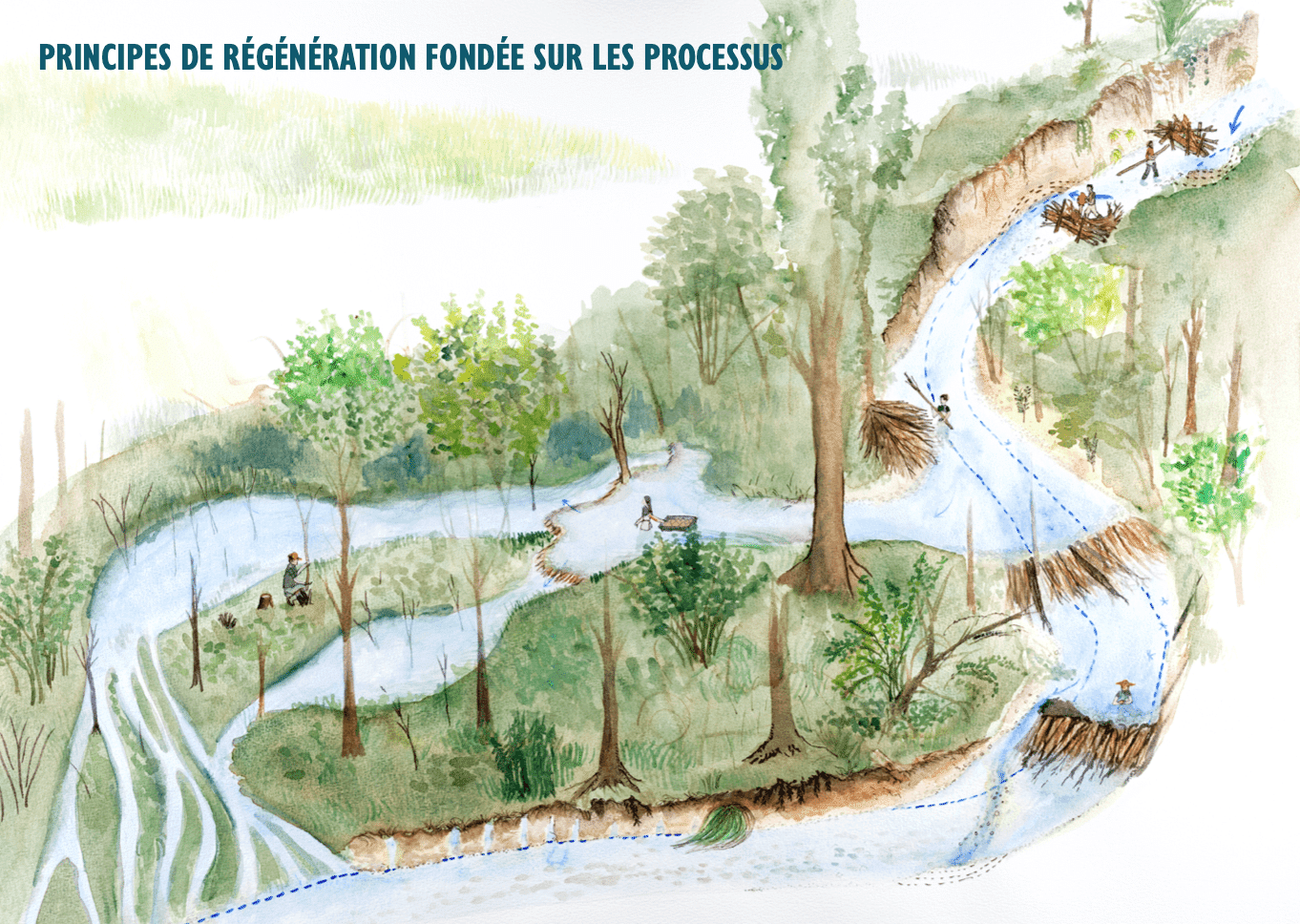
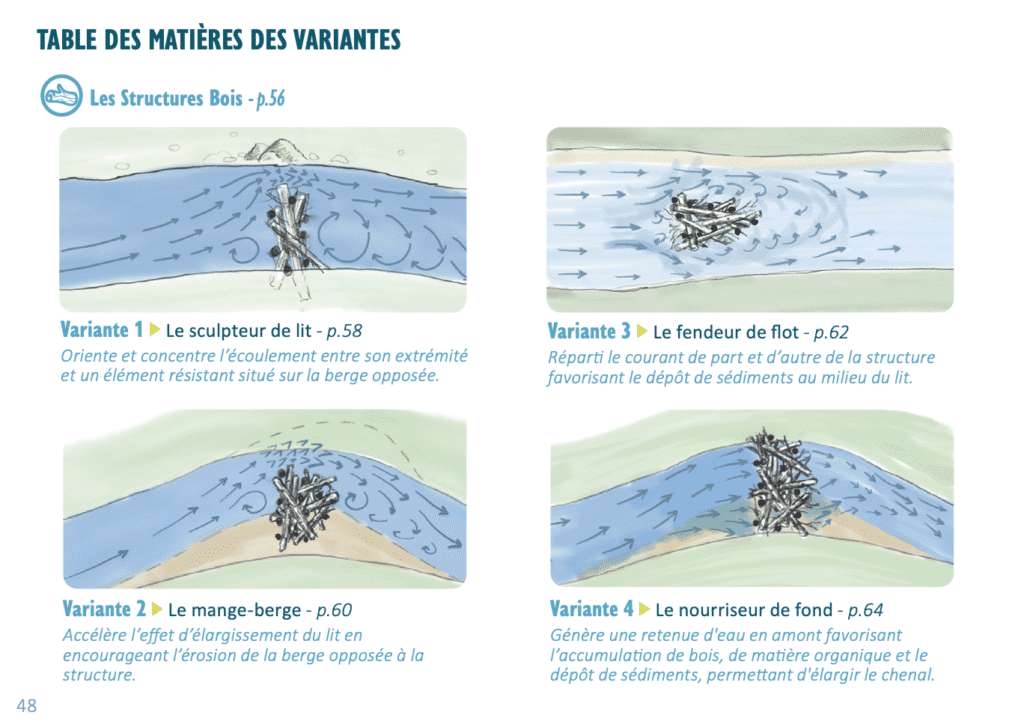
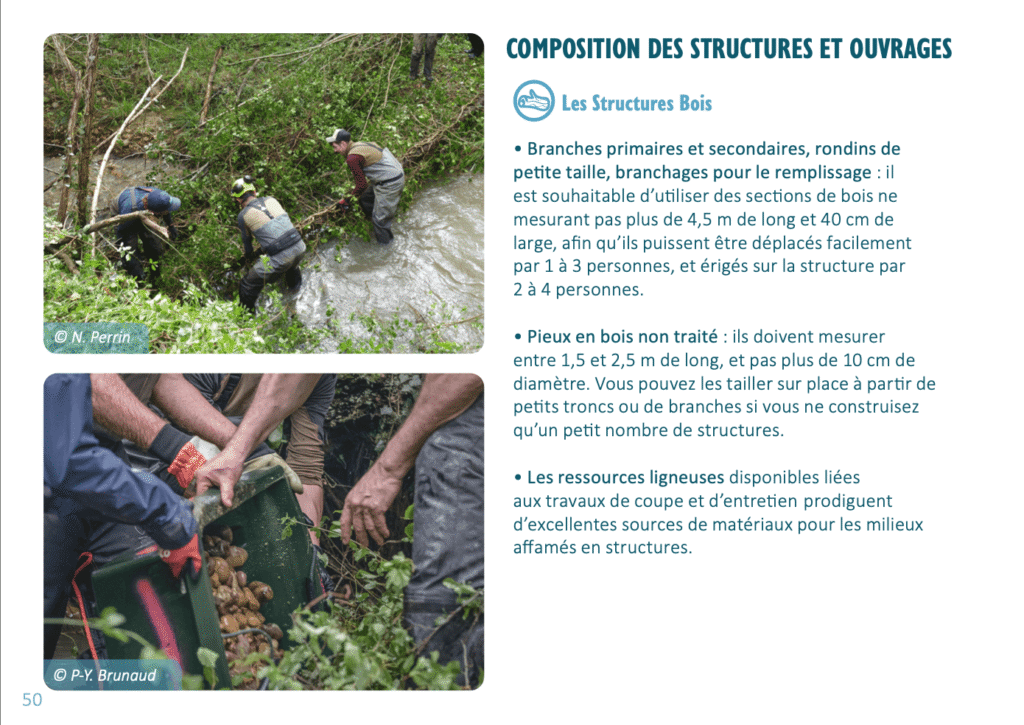
Stewarded by L’ARRAA and MAPCa, this translation also includes stunning artwork by our collaborator Suzanne Husky of MAPCa.
Last but not least on the translation front is our very own Gully Stuffing video. This translation was made possible by our partners at MAPCa and, again, Fanny Morizot, translator extraordinaire.

As the tour wrapped up, the team returned to the Fermes des Ségur in the Nouvelle-Aquitaine region to treat unmapped upland drainages. There, Kate and Kevin offered a daylong training to demonstrate best practices for working landscapes, offering practical solutions at a farm with vineyards, sheep, and cattle. 30 attendees helped add materials to existing structures and build brand-new ones. Wildlife camera traps indicate that the newly inundated areas are creating critical aquatic habitat for a variety of native bird, insect and wildlife species.
After this year’s ambitious training tour, Kate reflected on the immense progress our French collaborators have made on their strategic efforts to integrate PBR across the country. As we take notice of this success, in tandem with the stark realities of this summer’s fires, we look onward to the restorative collaborations and repair still to come.


